
When did you start playing sports, and what inspired you to begin?
I started swimming when I was very young, before I was five years old, in Balatonfűzfő under the guidance of Tibor Kenyeres. I was born with a minor condition affecting my leg (which I thankfully outgrew), so I wasn’t really able to participate in land-based sports as a child. However, I had endless energy, so my parents chose swimming as a way to keep me active. Thanks in large part to Coach Tibor, I quickly fell in love with the sport, and as it turned out, I was pretty good at it too.
How supportive was your family of your decision to study and compete abroad?
My parents were incredibly supportive. They wanted me to experience what it was like to live independently in a foreign country. My mom definitely missed me a lot, and she made sure I knew it, but we spoke on the phone regularly. Since the academic year always ended around the middle of May, I was able to spend more than three months at home every summer, making up for the time apart with my siblings, parents, and friends.
How did Study N Sport help you?
About two years before graduating from high school, they approached me with the idea of studying at an American university. Until then, I had never even considered it, so they were the ones who planted the idea in my mind. They helped me understand everything I needed to prepare before moving abroad, which would have been a huge challenge to figure out on my own. Since many athletes had already gone through Study N Sport, universities knew and trusted them, so I believe my emails received far more responses than they otherwise would have.
How did training in the United States compare to training in Hungary?
For me, the difference was enormous. I came from a relatively small swimming club in Veszprém, where our resources were much more limited.
In the U.S., I trained alongside many swimmers my own age. We had a dedicated strength and conditioning coach, as well as a trainer responsible for recovery and injury prevention. Practices were incredibly varied, and there was a huge emphasis on teamwork.
Swimming is ultimately an individual sport, but in the U.S., they do everything possible to make it feel like a team sport. That was one of my favorite aspects of the experience—it made me genuinely excited to go to practice every day.
How easy or difficult was it to adjust? How did you manage with the language?
Moving to a university with a team already in place is a huge advantage because you immediately have people around you whom you can rely on.
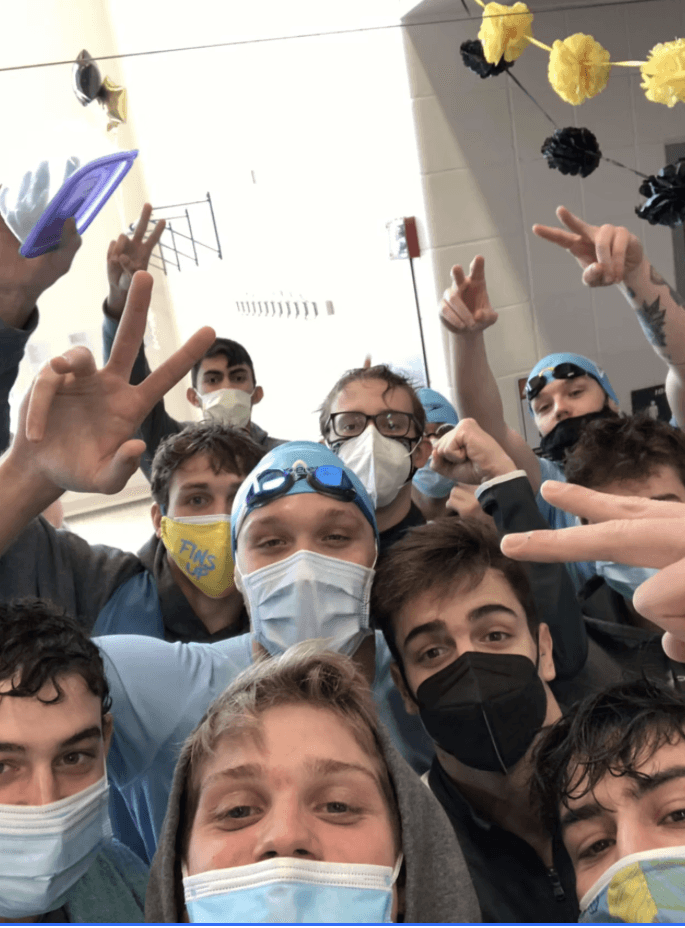
I moved to New York in September 2020, right at the peak of the COVID pandemic, so my first year was anything but typical. On top of that, our class was the very first men’s swimming team in the university’s history; previously, the school only had a women’s team.
Those two circumstances actually made our first year even more special. We all lived together in the same residence hall, and after the initial two-week quarantine, we basically spent all our time together for the first few months.
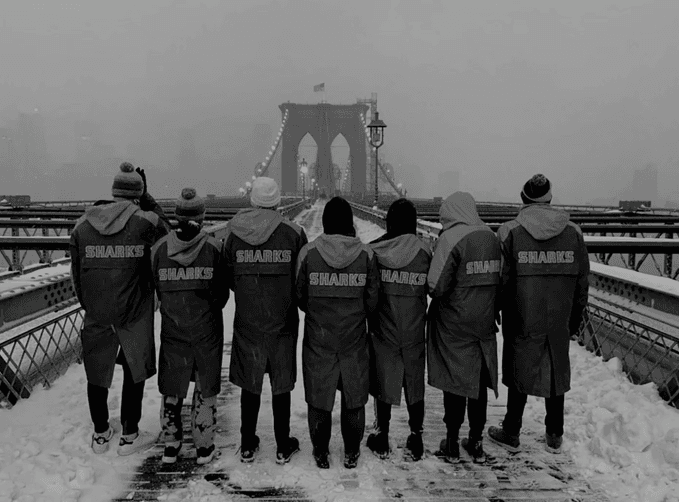
During that time, we built an incredibly close bond that I wish everyone could experience at least once in their lifetime. The best proof of that is that every single one of us who started together stayed at the university all four years. Nobody transferred.
We started together, and we graduated together.
How different was your diet compared to what you were used to in Hungary?
Our university cafeteria offered unlimited meals, which was fantastic as an athlete. It also made life much easier because we didn’t have to cook for ourselves.
Breakfast was excellent, with a huge variety of healthy options. I actually ate much better breakfasts there than I ever did at home, where mornings were always rushed.
Lunch and dinner, unfortunately, were a different story. Americans love deep-fried food, and those options were everywhere—alongside endless burgers and hot dogs. We often wished there were healthier choices because, aside from breakfast, eating well wasn’t always easy.
What did your everyday life look like?
I attended university in New York City, where there’s honestly never a dull moment.
During the competitive season, practices kept us extremely busy. In the offseason, however, we only trained once a day instead of two or three times.
Every day looked a little different, but classes, training, and work usually took up most of my schedule. I worked as a lifeguard at the university pool because living in New York is expensive.
I spent most of my free time with my teammates. Sometimes we’d just hang out in each other’s dorm rooms talking or playing video games. Other times we’d head into the city and explore, because New York offers endless opportunities.
What is your proudest achievement or favorite memory from your swimming career?
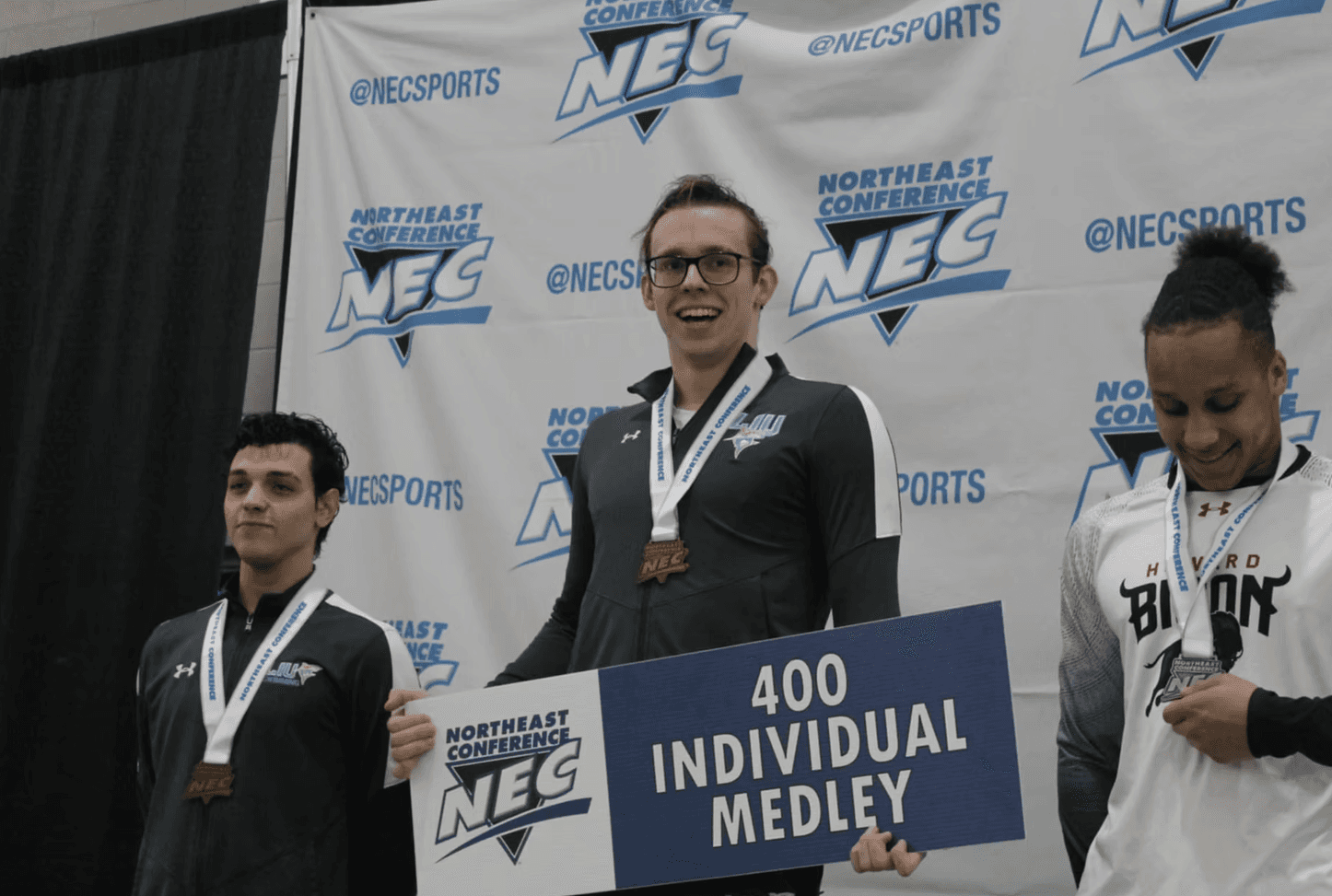
One of my favorite memories is winning the conference championship in the 400-meter individual medley in 2022.
During the final 100 meters, I was completely exhausted. I looked toward the stands and saw every one of my teammates on their feet, jumping, cheering, and screaming for me.
They carried me to the finish line.
When I looked back at them after the race, I felt an indescribable sense of happiness. Even today, I still get goosebumps thinking about it.
To make it even better, I also set a new conference record that day.
Beyond that, I have countless unforgettable memories—from training camps to all the moments shared with my teammates both in and out of the pool, whether in Hungary or the United States.
What do you love most about America? Does the “American lifestyle” really exist?
New Yorkers often say that New York is a completely different world from the rest of America, so I can’t really claim to represent the typical “American lifestyle.”
What I can say is that life there is fundamentally different from life back home.
The thing I appreciated most was how open-minded and accepting people were. Or perhaps it’s more accurate to say they simply don’t judge you for how you choose to live your life.
You can be yourself without worrying about being looked down upon or treated differently, and that creates an incredible sense of freedom.
What do you think about the American education system? What do they do differently?
American universities place much greater emphasis on project-based learning and teamwork than Hungarian universities.
I think the ideal approach is finding the right balance between collaborative work and more traditional academic methods.
Still, there’s no doubt that this style of education prepares students well for professional life, where you’ll most likely work as part of a team and need to solve problems together.
Which university did you attend, and what did you study?
I attended the Long Island University Brooklyn Campus, a relatively small university located in the heart of Downtown Brooklyn, about a 15-minute walk from the East River. Times Square was only twenty minutes away by subway, and Central Park about thirty.
I majored in Biology.
Can you tell us what you’re doing now? How has your life evolved since your years in the United States?
I’m currently studying in Hungary at Pázmány Péter Catholic University, in the Faculty of Information Technology and Bionics.
This year, I enrolled in a second bachelor’s program in Molecular Bionics Engineering, but my goal is to transfer into the master’s program next September using the credits I earn this year along with my American degree.
I felt I needed this foundation year because there are significant differences between the two fields. Together, though, they provide a unique perspective that I hope to use one day in scientific research.
What advice would you give to young athletes who are considering this path?
Go for it.
At first, it may seem intimidating, but I promise you won’t regret it.
Living abroad will make you more independent, broaden your perspective, and help you build lifelong friendships all around the world.
Because you’ll be immersed in an entirely new culture—and most likely in a highly international team—you’ll develop countless valuable life skills.
Some of those skills can’t be measured by medals or grades, but they’ll shape the way you see the world for the rest of your life, and that’s an advantage that will stay with you forever.
We want to get to know you better


