
When, what inspired you, or who influenced you to start playing sports?
As a child, I always loved being in the water. I was introduced to swimming through kindergarten swimming lessons when I was six years old, and somehow I never left the pool after that.
How supportive were your parents (family) of your plan to study and compete in sports abroad?
They supported me completely in every way, and they still do, even though the idea of me living on another continent was frightening for them as well. I consider myself very lucky to have such supportive parents.
How did Study N Sport help you?
They guided me through the entire process. They helped me prepare for the American entrance exams and assisted with communication with coaches and universities. Whenever I had a question or needed help, I could always turn to them—even three years after moving to the U.S., when I decided to transfer to another university.
How did training in the U.S. compare to training in Hungary?
In my experience, the training wasn’t as demanding as it was in Hungary. We spent fewer hours in the pool and swam fewer kilometers than I did back home. I especially enjoyed training and competing in a 25-yard pool. Short-course swimming has always suited me best.
How easy or difficult was it to adjust? How did you manage with the language?
It was fairly easy to fit into the team, even though I was the only Hungarian at the university. Fortunately, everyone was very welcoming, and I quickly built a great relationship with both my coaches and teammates. I did struggle with English at first. During the first few months, I mostly listened rather than spoke, but as my confidence grew, I became more comfortable joining conversations and expressing my opinions.
How was your diet in the U.S. different from what you were used to in Hungary?
The biggest difference was that I didn’t have to cook for myself. I ate all my meals in the university dining hall, which was much more convenient because I didn’t have to spend time or energy cooking. The food options were very different from what I was used to in Hungary. I especially missed Hungarian soups, but we were always able to find something delicious to eat in the dining hall.
What do your everyday life look like now?
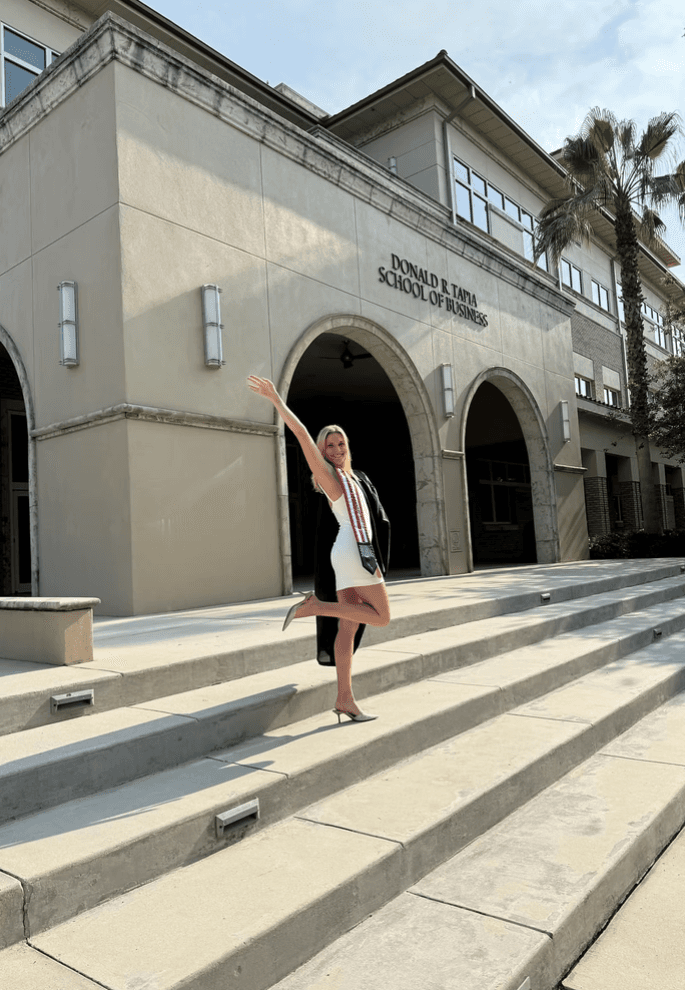
I graduated from Saint Leo University in May and have since moved back to Hungary. I am currently continuing my studies in the Master’s program in Psychology at Eötvös Loránd University (ELTE). I have retired from competitive swimming because I feel that my achievements in the United States represented the peak of my athletic career—something I am incredibly proud of. Now, my focus is on building a career in psychology and growing within the profession.
What has been your greatest achievement or favorite memory since you started swimming? What are you most proud of?
I could mention three achievements here—two from Hungary and one from the United States. In 2017, I became the Hungarian National Champion in the 50-meter backstroke, and in the same year, I finished second at the Hungarian Short Course National Championships while also setting a new national age-group record. During my second year in the U.S., I qualified for the NCAA Championships in the 100-meter backstroke, where I finished in eighth place. I still look at the little trophy I received for that eighth-place finish every day.
What do you like most about America? Do you think there is such a thing as the “American lifestyle,” and if so, how is it different from life in Hungary?
What I loved most about America was the weather and being so close to the sea and the ocean. During those four years, I had the chance to visit so many beautiful places, and I am incredibly grateful for that.
I think the American lifestyle is different because people generally don’t care about what you do, what you look like, or how you dress. Everyone is focused on their own life and accepts you for who you are, without judging you.
What do you think about the American education system? What do they do better—or simply differently—than in Hungary?
In my experience, the American education system is much more practical than the Hungarian one. I had many more hands-on classes, and both the coursework and exams were designed to assess how well you truly understood the material and how effectively you could apply it to real-life situations.
What are your future goals, both in sports and outside of sports (in the U.S. and beyond)?
As I mentioned earlier, I have retired from competitive swimming, so I no longer have athletic goals. Right now, I want to focus on my education. I am currently completing my Master’s degree at Eötvös Loránd University (ELTE). After graduating, I plan to pursue clinical psychology training, and eventually I hope to earn the title of psychotherapist.
I would gladly return to the United States in the future for conferences or specialized professional training, but I plan to build my life and career in Hungary.
We want to get to know you better


