
When, what inspired you, or who influenced you to start playing sports?
Sports have always been an important part of my family. My parents have been active in sports since they were young, and they always encouraged me to be active as well. When I was around four or five years old, I started swimming mainly because of my asthma. Later, I tried several other sports, such as dancing and basketball, but I never really found my place in them. I started athletics when I was ten years old at the same club where my younger sister trained. At first, it wasn’t easy because I didn’t really enjoy running, but over time I found my events—the long jump and triple jump. In the end, it was my coach and my teammates who motivated me to stay in athletics.
How supportive was your family of your decision to study and compete in sports abroad?
My family fully supported my decision to study and compete abroad. My father had studied in England during his university years, and he wanted my siblings and me to experience what it is like to live in another country. It was also very important for me to continue competing in athletics while attending university, something that unfortunately is not well supported in Hungary.
How did Study N Sport help you throughout your journey?
Study N Sport helped me from the very beginning. They approached me with the opportunity to study and compete in the United States, and they really planted the idea in my head. Once my parents agreed that we should go for it, they helped me contact NCAA Division I coaches and universities. Since they already had a strong network, I didn’t have to search for coaches on my own. Besides helping me establish connections with coaches, they also supported me in preparing for the SAT and TOEFL exams, gathering and submitting the necessary documents, and navigating the visa application process.
How were the training sessions in the U.S. different from those in Hungary?
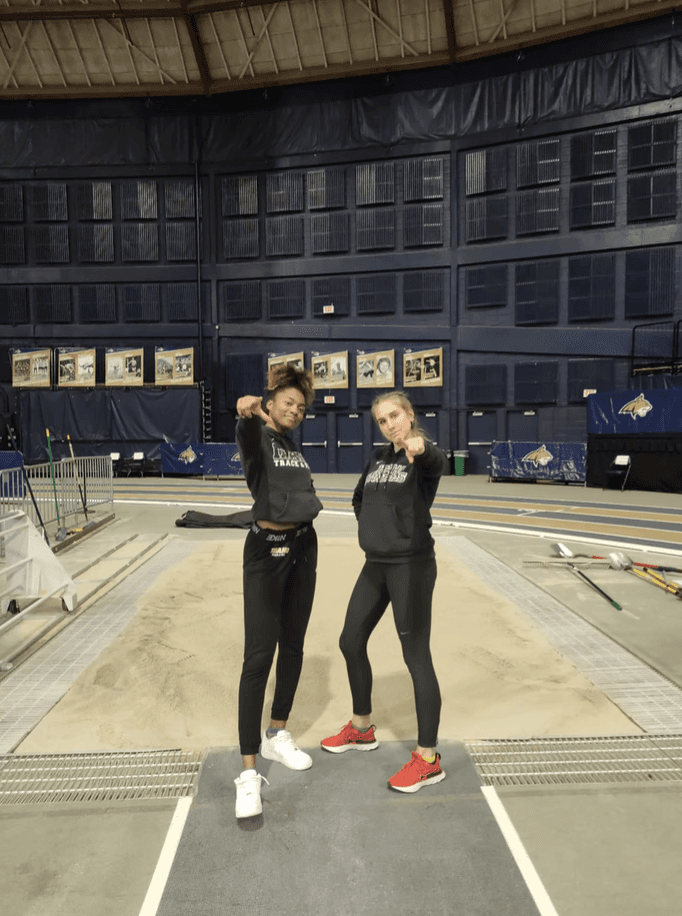
The biggest difference for me was the strength training. We had proper weightlifting sessions at least three times a week, whereas in Hungary, even when we had gym sessions, they involved much lighter weights and were less intense. Another major difference was that whenever I was injured or dealing with leg pain, I could train and even practice jumping on an underwater treadmill, something I had never even heard of back home.
How easy or difficult was it to adapt? How did you manage with the language?
The beginning was challenging, especially because I moved from a big city to a very small town in the middle of nowhere. I experienced culture shock from every direction, but over time I gradually settled in. It also helped that I wasn’t the only international athlete on the team—there was another European athlete as well. Studying and communicating in English was difficult at first because my brain had to completely switch languages, but after the first six months I became much more comfortable. My professors were also very understanding, which made the transition easier.
How different was your diet in the U.S. compared to Hungary?
My eating habits were probably where I experienced the biggest culture shock. During my first year I had to eat in the university cafeteria, and honestly, it wasn’t great. There were plenty of options, but around 80% of the food was either greasy or deep-fried, so eating healthy wasn’t easy. Restaurant portions were enormous—I could almost never finish them. At first I ate much fewer fruits and vegetables than I did at home, partly because I didn’t have my own kitchen. I also found it unusual that all three main meals were hot meals, which I wasn’t used to. Once I had my own kitchen, I gradually returned to an eating style much closer to what I had back home.
What did your everyday life look like?
Most of my practices were in the mornings, so I woke up early and usually finished training by around 11 a.m. During the day I attended classes, sometimes with one-hour breaks in between, and three afternoons a week I also had strength training. If my practice happened to be in the afternoon, my schedule didn’t really change because I still had classes every day. Besides studying and training, I worked at university sporting events, which usually took place in the late afternoon or early evening. Since I lived in a fairly small town, there wasn’t much else to do, so my friends and I would occasionally go into town for coffee, food, movies, or simply drive around the area.
What has been your greatest achievement or favorite memory in your athletic career? What are you most proud of?
One of the achievements I’m most proud of happened back in Hungary, when I won the national triple jump championship in 2018. That result secured my opportunity to study at a university in the United States. I also have many wonderful memories from competitions in America. We traveled to many places and competed at some incredible venues. One of my competitions took place at Hayward Field, the same stadium that hosted the 2022 World Athletics Championships. Another unforgettable moment was when our women’s track and field team finished third at the Big Sky Conference Championships, which was a huge accomplishment for us.
What do you like most about America? Is there really such a thing as the “American lifestyle,” and how is it different from life back home?
I do think the American lifestyle exists, although it’s not quite as glamorous as people often imagine. During my first two years I definitely felt that excitement, but after a few years the “honeymoon phase” gradually faded. As an international student, you eventually realize that life is more complicated because visa and immigration issues are always in the back of your mind. Once you get past that, though, you really get to experience American life. People here enjoy making life comfortable for themselves whenever they can afford it, and everything is designed around convenience and fast service. America is an incredibly large and beautiful country with natural landscapes unlike anything I had ever seen in Europe. Every state has something unique to offer, and there’s always something new to discover. People are also very kind and generous. Several of my friends’ families invited me to spend holidays with them when I couldn’t travel home, and I was welcomed into their homes on many occasions.
What do you think about the American education system? What does it do better or differently than the Hungarian system?
I originally came to the U.S. because of sports, but I stayed because of the education. The system has been a perfect fit for me, especially after I discovered what I truly wanted to study. Anthropology is much more established and comprehensive in the United States than it is in Europe. In addition, classes focus far more on critical thinking, teamwork, and applying knowledge than on memorization and lectures, which I believe prepares students much better for the future.
What are your future goals, both in sports and outside of sports?
This spring I completed my master’s degree here in the United States, and over the next year I plan to focus on working and gaining professional experience. My goal is to earn a PhD and eventually move back to Europe to work as an archaeologist. Although I have retired from triple jump, I haven’t stopped being active. Now it’s time for me to try new sports that I never had the chance to experience before.
We want to get to know you better


