
When, what inspired you, or who influenced you to start playing sports?
Swimming is one of those sports that is very difficult to learn properly if you don’t start as a child. A great example is my father, Zoltán Bozsó, who discovered triathlon at the age of 30, where strong swimming skills are essential. You could say that we almost started swimming at the same time—I was four years old, and he was thirty. Swimming was always my foundation sport. The goal was simply to build a solid swimming technique, and now I’ve been swimming between two walls for over 20 years—sometimes they’re 25 yards apart, other times 50 meters.
How supportive were your parents (family) of your plan to study and compete in sports abroad?
Anyone who knows us would probably describe us as a very sporty family. Our cars are always parked at the swimming pool, our weekends are planned around competitions, and it takes countless sacrifices to stay at the top both mentally and physically.
I’m the type of person who believes that everything happens for a reason. In 2013, my father qualified for the Ironman 70.3 World Championship in Las Vegas. I still remember the day he asked me, “What if one day you could study and compete in the United States on an athletic scholarship?” I was only 13 years old, and I thought things like that only happened in movies. Yet five years later, it became my reality.
That shows just how much my parents contributed to my journey. They drove me to early morning and afternoon practices, bought me all the equipment I needed, and made sure I ate properly. I’m also an only child, and there’s a reason for that. My parents wanted to give me every opportunity to succeed in life.
When I received my scholarship offer from an American university, there wasn’t a moment of hesitation on their part. They knew this was the right path for me and that it was an opportunity that could change my future.
How did Study N Sport help you?
At first, I honestly thought the message I received from Study N Sport on Messenger was spam. Then I realized it was real. I worked with them for two years, and without them I would never have earned a scholarship.
Of course, I had to deliver the results in the pool, but they helped with everything else. They assisted with my visa and SAT registration, connected me with college coaches, actively participated in Skype meetings, and handled countless other details. Managing all of that alone would have been extremely difficult and time-consuming.
Study N Sport is a very friendly, professional, and supportive recruiting agency. They genuinely care about their athletes, and I am still incredibly grateful to them.
How does training in the U.S. compare to training in Hungary?
Hungarian national swimming coach Csaba Sós once said in an article that swimmers who move to the U.S. are overwhelmed during their first semester. I completely agree.
If you come from the Hungarian swimming system, you already have one huge advantage: your endurance. I swam enormous training volumes and countless kilometers in Hungary. However, once you arrive in the U.S., you have to forget almost everything you know and relearn the sport.
American coaches pay incredible attention to detail. Turns, starts, underwater phases, and finishes are perfected centimeter by centimeter. There are many hypoxic workouts with underwater drills, and every practice is planned down to the second. The training is much more intense.
Strength training is also extremely demanding. They love low-repetition, heavy-weight workouts. In my opinion, both the Hungarian and American systems have their strengths and weaknesses. The future champions will be those who successfully combine the best of both approaches.
How easy or difficult was it to adjust? How did you manage with the language?
To be honest, I never really learned English well in elementary or high school. When I first arrived in the U.S., I barely spoke for the first three months. But when you’re living in the language 24 hours a day, you naturally improve and become more confident.
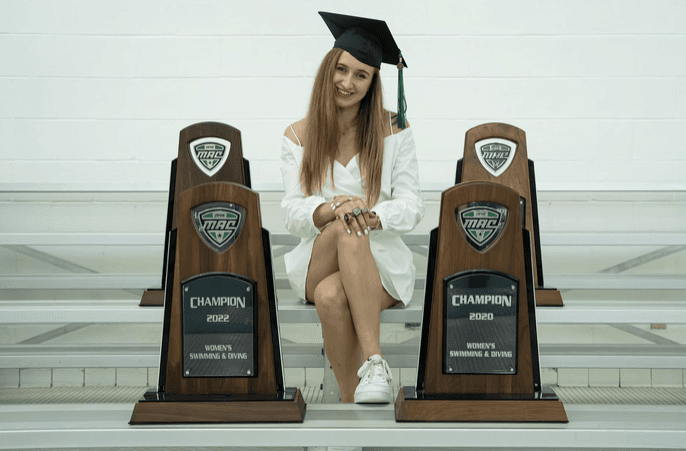
International students are highly appreciated, and everyone at the university was incredibly helpful. I was the first Hungarian student-athlete at the University of Akron. Today, I hold an American degree, which took a tremendous amount of hard work to earn.
How was your diet in the U.S. different from what you were used to in Hungary?
If I had to mention one downside of living in the U.S., it would be the food.
Yes, there was plenty of variety, and student-athletes could eat for free on campus, but the nutritional quality of the food wasn’t ideal for high-performance athletes. It was difficult to find fresh, high-quality ingredients, and the food simply wasn’t prepared the way I was used to. I missed my mother’s home-cooked meals very much.
What did your everyday life look like?
Our training schedule changed almost every year.
Typically, we started swimming at 7:00 a.m., followed by a quick breakfast. Then I had two 75-minute classes before lunch. After lunch came strength training, followed by another two-hour swim practice in the afternoon. If you were lucky, you could finally go home to eat dinner and study.
Sometimes, depending on my class schedule, I still had to attend evening classes after completing four hours of training that day.
Being a student-athlete also meant participating in countless team-building activities, which required even more time. Balancing everything was definitely challenging.
What has been your greatest achievement or favorite memory since you started swimming? What are you most proud of?
Every year, we held our training camp in either Fort Lauderdale or Naples, Florida. I absolutely love Florida.
My final collegiate competition was also held there: the CSCAA National Invitational Championship. Any swimmer with at least an NCAA Division I “B” qualifying standard could compete.
The moment I walked into the pool, I knew it was going to be a great meet. The water was incredibly cold—which was perfect for me.
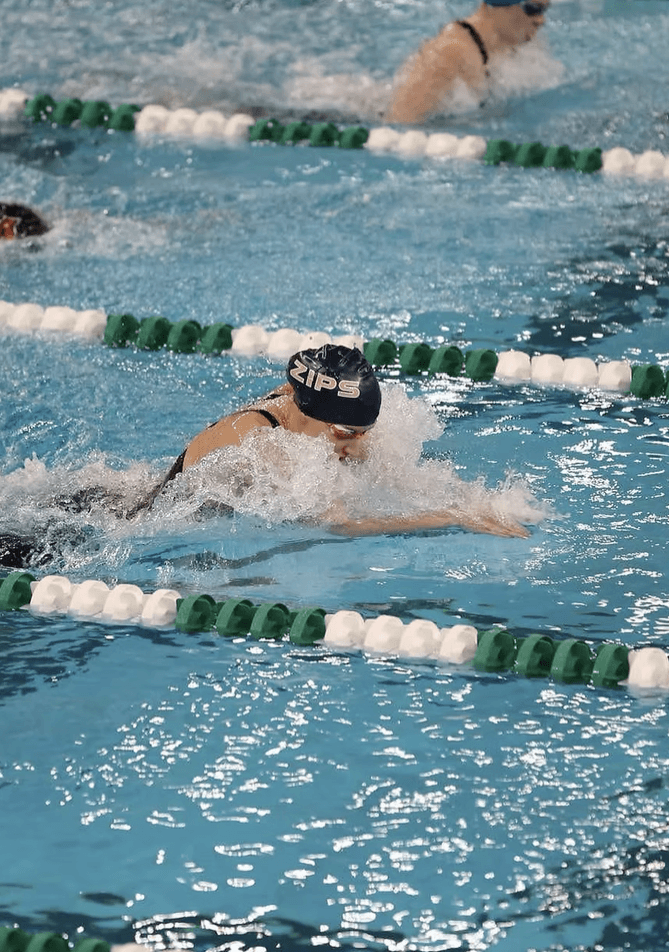
On the first day, I competed in the 50-yard breaststroke. During the morning preliminaries, I broke the University of Akron school record and qualified for the final with the third-fastest time.
I couldn’t wait for the evening final. My teammates even joked with me at the starting blocks because I was racing against much taller and stronger sprint specialists. My smaller build and swimming style have always been better suited to middle-distance events than sprinting.
The only thing I remember from that race is that I never looked left or right—I just gave everything I had.
I touched the wall first.
The result was a new University of Akron record and a new championship record. I looked at the scoreboard four times just to make sure I was really seeing the number 1 next to my name.
Throughout the rest of the meet, I set several personal bests, reached multiple finals, and had many successful relay performances.
Florida will always hold a special place in my heart.
What do you like most about America? Do you think there is such a thing as the “American lifestyle,” and if so, how is it different from life in Hungary?
I spent the busiest and most exciting five years of my life in America. Back home, I felt like I was stuck in a routine where very little changed and most days looked the same. In the U.S., something was always happening. We were constantly planning new activities, exploring new places, and simply enjoying life together.
I also built a huge circle of friends there. They are the ones who truly made those years so special.
What do you think about the American education system? What do they do better—or simply differently—than in Hungary?
It’s difficult for me to make a direct comparison because I never attended a Hungarian university, nor did I plan to. I didn’t apply to any universities in Hungary because I had already accepted my scholarship offer from the University of Akron before graduating from high school.
One thing is certain: students are highly valued in the United States, and people are incredibly supportive. I still keep in touch with my professors today, and I owe them a great deal. The entire university staff works hard to provide students with the support they need. You quickly get used to how efficiently they solve problems and how willing they are to help in any situation.
What are your future goals, both in sports and outside of sports (in the U.S. and beyond)?
I had hoped to stay in the United States after graduation, but obtaining a new visa is not easy.
In the future, I would like to become a swimming coach in the U.S.
Until then, I’ve returned to training in Hungary, spending four to five hours a day back in the pool. Right now, my focus is simply on putting in the work that’s necessary to achieve great results while training in Kaposvár.
We’ll see what the future has in store.
We want to get to know you better


